How do you become a pharmacy technician?
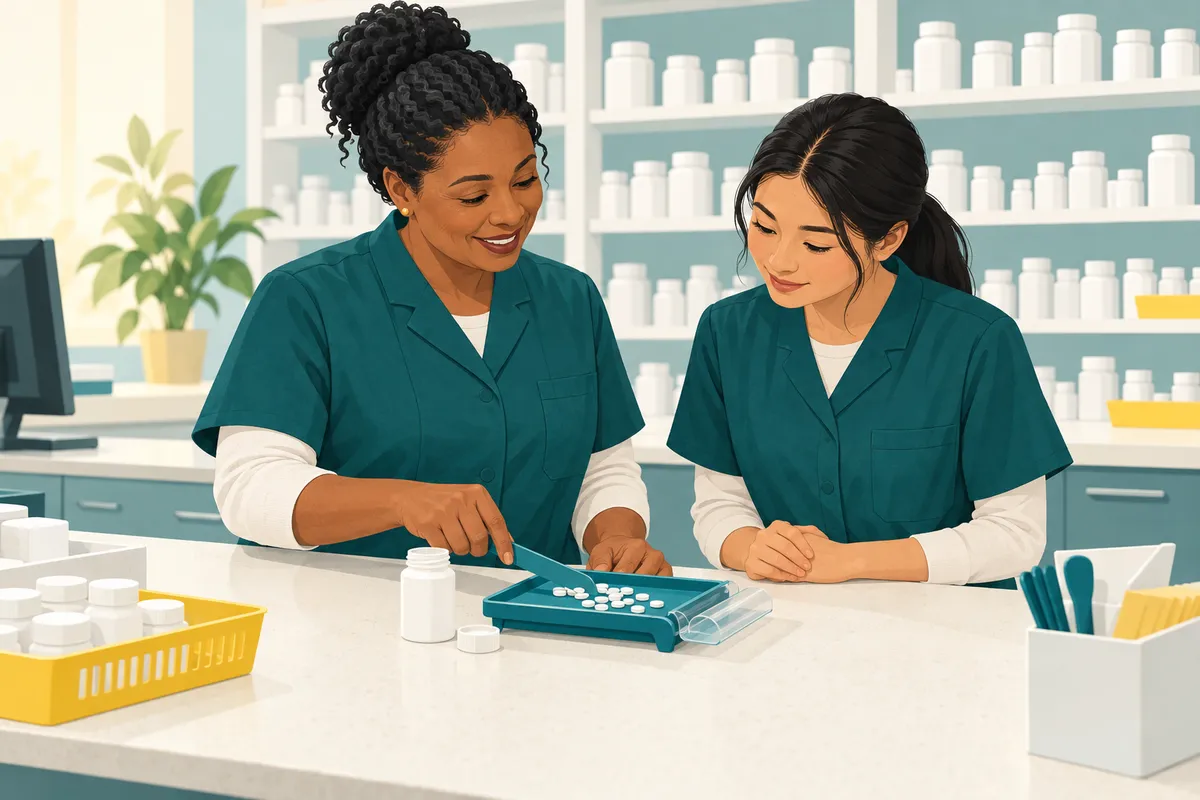
To become a pharmacy technician, you usually need a high school diploma or GED and training in a formal program or on the job. You also need registration or a license from your state board of pharmacy. Many states and employers also want national certification through PTCB's CPhT exam ($129 in 2026) or NHA's ExCPT. Training usually takes under a year (BLS).
Key takeaways
5 points · under 1 min- BLS: techs typically need a diploma or GED; on-the-job training usually takes under a year.
- PTCB's CPhT exam costs $129 in 2026 and accepts a PTCB-Recognized program or 500 work hours.
- NHA's ExCPT accepts a training program from the last 5 years or 1,200 supervised work hours.
- From January 1, 2027, accredited tech programs must include at least 400 hours (ASHP/ACPE).
- State rules differ: Texas requires certification for full registration; California accepts other routes too.
In this article 8 sections · 7 min read
- What are the steps to become a pharmacy technician?
- Do you need a high school diploma to be a pharmacy technician?
- Should you take a pharmacy technician program or train on the job?
- How do you register with your state board of pharmacy?
- Which certification should you get: PTCB or NHA?
- How long does it take to become a pharmacy technician?
- How do you keep your pharmacy technician certification?
- Quick answers
What are the steps to become a pharmacy technician?
Most people follow five steps: finish high school, get trained, get a state credential, pass a national certification exam, and keep everything renewed. The details change by state, because your state board of pharmacy sets the rules where you work. According to the Bureau of Labor Statistics (BLS), most states regulate the job in some form.
- Earn a high school diploma or GED.
- Get trained, in a formal program or on the job.
- Register or get licensed with your state board, if your state requires it.
- Pass a certification exam: PTCB’s PTCE or NHA’s ExCPT.
- Renew your certification and your state credential on schedule.
Here is the path at a glance, using official figures as of October 2026.
| Step | What you need | Typical time |
|---|---|---|
| 1. Diploma | High school diploma or GED | Before you apply (some programs let you finish it alongside) |
| 2. Training | A formal program, or on-the-job training | Usually under 1 year either way (BLS) |
| 3. State credential | Registration or license from your board | Texas: at least 8 weeks to process |
| 4. Certification | PTCB CPhT ($129) or NHA ExCPT | PTCB posts official results within 3 weeks |
| 5. Renewal | Continuing education (CE) and a fee | Every 2 years for PTCB, NHA and Texas |
Do you need a high school diploma to be a pharmacy technician?
Yes, in most cases: BLS says pharmacy technicians usually need at least a high school diploma or equivalent to enter the field. Several checkpoints ask for it:
- NHA requires a diploma or GED for the ExCPT, or that you’ll earn one within 60 days (NHA Candidate Handbook, June 2026).
- California won’t issue a technician license without proof that you graduated high school or hold a GED.
- Texas accepts technician and trainee applicants who are still working toward a diploma or GED.
- ASHP/ACPE-accredited programs may enroll students who are still in high school, under the 2026 standards.
PTCB’s published CPhT eligibility rules focus on training or work experience, not a diploma, but your state’s rules still apply.
Should you take a pharmacy technician program or train on the job?
BLS describes both as normal ways into the field. On-the-job training usually takes under a year, with experienced technicians showing you the work. Formal programs are offered by vocational schools and community colleges; many award a certificate in a year or less, and some lead to an associate degree.
If you choose a program, check two things before you enroll:
- ASHP/ACPE accreditation. The American Society of Health-System Pharmacists (ASHP) and the Accreditation Council for Pharmacy Education (ACPE) accredit technician programs together. They do it through the Pharmacy Technician Accreditation Commission (PTAC).
- The new 400-hour rule. ASHP/ACPE approved new standards in January 2026, effective January 1, 2027. They replace the entry-level and advanced tracks with one program type of at least 400 hours. That means 100 didactic, 50 simulation and 120 experiential hours, plus 130 hours the program allocates. At least two-thirds of the experiential hours must happen in a dispensing pharmacy.
- PTCB recognition. To qualify for the PTCB exam through training, your program must be a PTCB-Recognized Education/Training Program. PTCB keeps a directory of these programs, so ask the school to show you its listing.
Also confirm that your state board accepts the program. Texas trainees, for example, must complete a board-approved one.
Learning on the job instead? PTCB accepts at least 500 hours of pharmacy technician work experience in place of a program, finished by the time you apply. At 40 hours a week, that’s about 13 weeks.
How do you register with your state board of pharmacy?
Check your state board first, because it decides whether you need a registration, a license or nothing at all. BLS says regulating states typically ask for some mix of a diploma, a training program, an exam, fees, continuing education, a criminal background check and a minimum age.
Two examples from official board pages, as of October 2026, show how much the rules differ:
- Texas requires current PTCB or ExCPT certification for full registration. Without it, a technician trainee registration lets you work while completing a board-approved training program for up to two years, and it can’t be renewed. Allow at least eight weeks for processing, plus fingerprinting.
- California treats certification as one route among several. You need a high school diploma or GED, plus one qualifying route. PTCB certification or an ExCPT certificate dated January 1, 2017 or later each count. So do an associate degree in pharmacy technology, a course of at least 240 hours, an ASHP-accredited course, pharmacy school graduation or military training.
Other states set their own lists, so read your board’s current application before you pay for training.
Which certification should you get: PTCB or NHA?
Start with the one your state board and employer accept. Both PTCB and NHA award the Certified Pharmacy Technician (CPhT) credential, and both programs are accredited by the National Commission for Certifying Agencies (NCCA).
The eligibility routes are what most new technicians compare first:
- PTCB (PTCE): live in the US or its territories. Then either complete a PTCB-Recognized Education/Training Program (or be within 60 days of finishing one) or log 500 hours of work experience. A pharmacy degree can stand in for the program. You must disclose criminal history and any state board actions, and the fee is $129.
- NHA (ExCPT): hold a diploma or GED, or be within 60 days of earning one. Then either finish a pharmacy technician training or education program within the last 5 years, or log 1,200 hours of supervised pharmacy work. Those hours must fall in one year within the last 3 years.
Our PTCB vs ExCPT comparison covers question counts, passing scores, test locations and state acceptance in detail.
If you’re heading for the PTCE, take our free PTCB diagnostic test to find your weak areas. Then work through the full-length PTCB practice test with a 110-minute timer running, like the real exam.
How long does it take to become a pharmacy technician?
Plan on several months at a minimum, and a year or more for a longer program or an associate degree. Training is usually the slowest part.
- Training: BLS says on-the-job training typically lasts under a year, and many program certificates take a year or less.
- Work-experience route: 500 hours for PTCB is roughly 13 weeks full time, or about 25 weeks at 20 hours a week.
- Exam results: PTCB posts official PTCE results within three weeks. NHA posts ExCPT results from a PSI test center or remote exam within 48 hours.
- State processing: Texas asks applicants to allow at least eight weeks, longer if criminal history needs review.
Some states let you work while you train, as Texas does with its trainee registration. Check what your board allows.
How do you keep your pharmacy technician certification?
You renew your certification every two years, and your state credential on its own schedule. Both a PTCB CPhT and an NHA CPhT need 20 CE hours per cycle, including at least one hour of pharmacy law and one of patient safety.
PTCB opens renewal 60 days before your expiration date and adds a $25 late fee if you apply later than 30 days before it. Texas renews technician registrations every two years too, with its own CE rules.
Our PTCB exam hub brings lessons, tests and study tools together. HealthcareExams is independent and not affiliated with PTCB, NHA, ASHP or ACPE.
Quick answers
How long does it take to become a pharmacy technician? Usually several months to a year. Training is often under a year (BLS), and exam results and state processing add a few weeks to a few months.
Can you become a pharmacy technician without going to school? Often, yes. PTCB accepts 500 hours of work experience instead of a program, but some states require a formal training program, so check your board first.
How much do pharmacy technicians make? The median annual wage was $45,750 in May 2025, and hospitals paid a median of $50,760 (BLS).
Can you take the pharmacy technician exam online? NHA offers the ExCPT by live remote proctoring. PTCB gives the PTCE only in person at Pearson test centers.
Is certification required in every state? No. Texas requires PTCB or ExCPT certification for full registration, but California also accepts education and military routes, so check your state board.
Ready to see where you stand? It's free to start, and every answer is explained.
Sources
- BLS Occupational Outlook Handbook, Pharmacy Technicians
- PTCB, Certified Pharmacy Technician (CPhT)
- PTCB Help Center, How do I recertify my CPhT Certification?
- NHA, Candidate Handbook (updated June 1, 2026)
- ASHP/ACPE Accreditation Standards for Pharmacy Technician Education and Training Programs (2026)
- Texas State Board of Pharmacy, How to Become a Pharmacy Technician in Texas
- California State Board of Pharmacy, Pharmacy Technician Application and Instructions
Written with AI and checked against the sources above by a separate review step. No pharmacist reviews this content. How we make our content.
HealthcareExams is an independent study resource. It is not affiliated with, endorsed by or sponsored by ATI (Assessment Technologies Institute), Elsevier/HESI, NCSBN or the Pharmacy Technician Certification Board (PTCB). TEAS and ATI TEAS are registered trademarks of Assessment Technologies Institute, LLC. HESI is a registered trademark of Elsevier Inc. NCLEX and NCLEX-RN are trademarks of NCSBN. PTCB, PTCE and CPhT are trademarks of the Pharmacy Technician Certification Board.